Post by Vic Elizabeth Turnbull, MIC Founder
I often leave podcast festivals or industry events feeling a bit… deflated.
They can feel disconnected from the reality of the indie podcasters and community storytellers I work with every day.
Most of us are in our kitchens, wardrobes, community centres and under the stairs actually making podcasts.
But the International Women’s Podcast Festival was the opposite of that.
I left with a proper spring in my step and happily skipped my way back to Manchester.
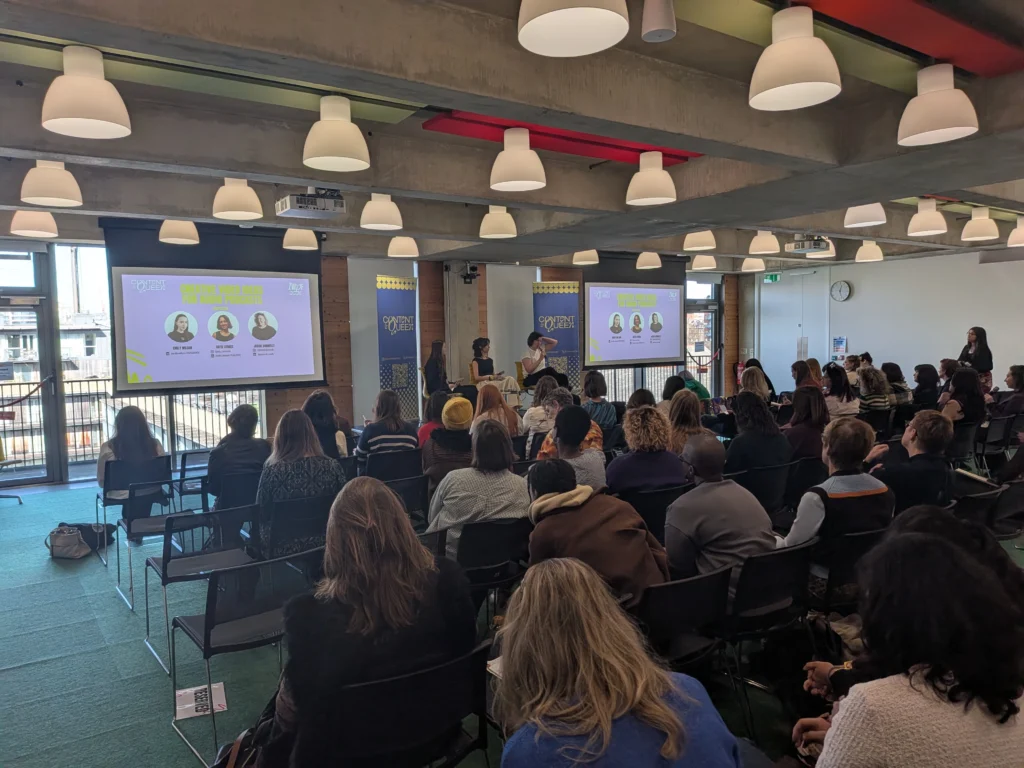
A room full of lovely podcast people
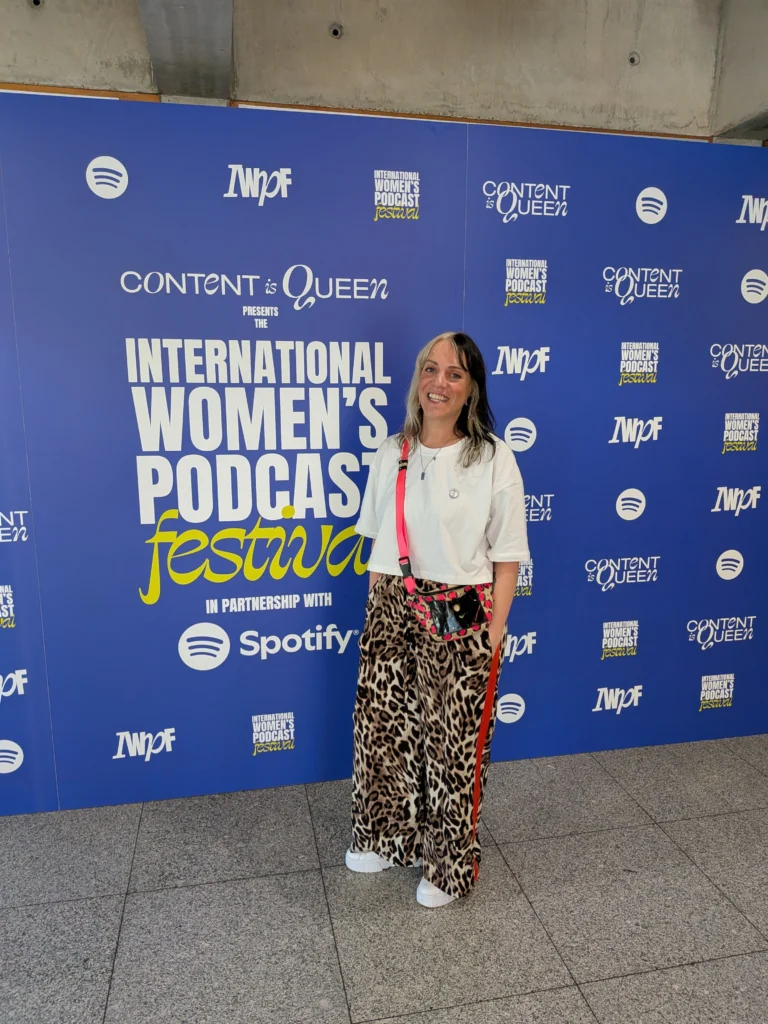
The festival, presented by Content is Queen in partnership with Spotify, brought together a brilliant mix of people from across the audio world.
There were podcasters already making shows, people thinking about starting one, producers and folks working across the industry and curious audio lovers wanting to learn more.
In a nutshell, the actual people who make podcasting what it is.
And it was just lovely to see everyone in real life.
Podcasting can be a lonely adventure.
You’re recording interviews online, editing episodes into the wee hours, often sat in the dark hunched over your laptop.
The podcast itself is usually the only public outcome, but people rarely see the behind-the-scenes, that one person squirrelling away making the whole thing happen.
You’re juggling recording, editing, writing show notes, posting on socials, chasing guests, fixing audio issues and generally being a master of all trades.
And half the time you’re learning it all as you go, when this time last year you didn’t know your MP3 from a USB microphone.
So days like this, when all those people in the same room, feel pretty special.
Everyone was warm, supportive and curious. There was no competitiveness. Just people excited to share ideas and talk about podcasting.
And the team running the day were brilliant, smiley, welcoming and super helpful from the moment you walked through the door.
You could also tell a lot of thought had gone into how the day was structured.
Instead of the usual conference mess, where you’re legging it between talks and nothing sinks in, the sessions were longer and there were proper breaks built in between them, so conversations could breathe
There was even a quiet room for anyone needing a bit of space away from the bustle.
And lunch was provided too.
Now this might sound like a small thing, but it matters.
When we ran Pods Up North back in 2019, one of the biggest bits of feedback we got afterwards was simply:
“Thanks for feeding us.”
Turns out podcasters really appreciate lunch.
To top it all off, the sun was shining too.
17 degrees in March? London, you absolute flirt.
Why spaces like this matter
If you spend five minutes looking at the top podcast charts in the UK, you’ll notice something pretty darn fast.
There still aren’t that many female voices front and centre.
Now, the production teams behind those shows may well be more balanced — but from the outside looking in, it can still feel like the industry is dominated by the same handful of formats, voices and big-name personalities.
Which is why spaces like the International Women’s Podcast Festival are so important.
Because podcasting didn’t start as a corporate industry.
It started with people mucking about with RSS feeds and microphones, discovering they could spout about their passions and convince a few others to come along for the ride.
Indie creators built this thing.
Podcasting has never really had just one definition of success either.
For some shows, success might mean chart positions, sponsors and huge audiences.
But for others it might look like building a community, starting conversations, supporting a cause, or giving people a space to share stories that otherwise wouldn’t be heard.
The more space we create for different kinds of creators, the more definitions of success we get to see.
Events like this — along with the likes of the International Women’s Podcast Awards, the Independent Podcast Awards, Multitrack and podcaster communities like MIC’s Podcast Club — help rebalance the scales a bit.
They champion independent voices, women creators and new ideas.
Podcasting needs this energy.
Because if everything starts looking and sounding the same, the whole thing ends up like a huge plate of beige food. And that’s just boring. Podcasting shouldn’t be vanilla.
A Few Things That Stayed With Me
There were loads of brilliant sessions across the day, but here’s some of the conversations that really stuck with me.
1. You don’t have to do video to make your podcast work
One of the first talks I went to explored creative ideas for audio podcasts, featuring Katie Stokes (freelance audio producer), Jessie Donnelly (creative producer at Cold Glass Productions and Screamers podcast, supporting BBC Sounds and BBC Radio), and Emily Wilson (format developer and podcast assistant producer).
The conversation tackled one of the biggest pressures in podcasting right now – video.
At the moment there’s a growing sense that every podcast needs a video version.
With posh studio cameras, multiple angles, samey backgrounds and clipping the shit out of everything.
And if you don’t do it, you’re behind, you’re a loser, stop podcasting you fraud.
But the panel pushed back on that idea, which I loved.
If you’re passionate about visuals, brilliant. Crack on.
But if you’re not? That’s fine too.
Audio is still incredibly powerful. Some of the most beautiful storytelling has been created purely through audio and has been for decades.
Another important point was cost.
Not everyone has BBC-sized budgets or a posh studio setup.
Some creators are filming content on their phones balanced on a £15 tripod. And do you know what? That’s absolutely fine pal.
There was also a really interesting conversation about AI-generated content.
One of the speakers made the point that audiences are starting to push back against AI “slop” – overly polished content that looks impressive but feels a bit… soulless.
You might make something less swanky and polished.
But it has your voice, your quirks and your perspective. And that matters far more, especially for your audience.
2. Video should have a purpose
The discussion around video wasn’t about chasing trends.
It was about intentionality.
If you’re using video to promote your podcast, ask yourself:
- What problem does this video solve for your audience?
- Where are your listeners actually spending their time online?
- What’s the entry point into your podcast world and is it the same everywhere?
Clips can be brilliant for pulling people into your show. Behind-the-scenes moments, bits that didn’t make the final edit, or slightly sillier content can help build the world around your podcast.
But the key message was this: You don’t have to be everywhere.
For independent podcasters, keeping one or two platforms running well is often far more manageable than trying to spin plates across five.
3. Your podcast can grow beyond the audio
Another brilliant panel explored how podcasts can expand into something much bigger than the audio feed.
Speakers included Liv Bolton from The Outdoors Fix, Astrid Madimba and Chinny Ukata from It’s A Continent, and Jane Gerber from Get Birding. Each of them had grown their podcast into something that reached far beyond the headphones of their listener.
For example:
- The Outdoors Fix has organised hiking groups for listeners, bringing the audience together in real life.
- It’s A Continent has hosted film events and expanded their podcast into a book.
- Get Birding has branched into games, education and animation.
The common thread was that they all listened to what their audience actually wanted.
Podcasting doesn’t have to stay in the audio feed. It can grow into events, books, communities and movements.
How could your podcast connect with your community in new ways — and reach people who might never normally listen to podcasts?
4. Funding podcasts doesn’t have to mean ads
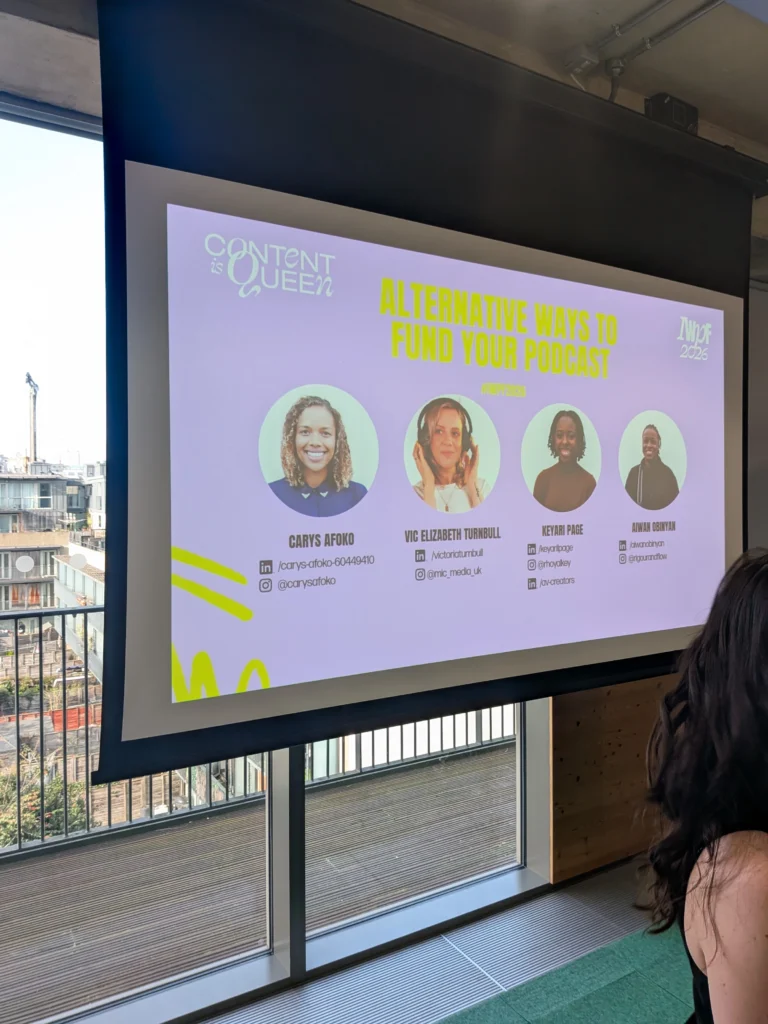
I also had the joy of speaking on a panel about alternative ways to fund your podcast, alongside Keyari Page (content and brand account manager at AVC), Aiwan Obinyan (co-host of Rigour & Flow and founder of AiAi Studios), and moderator Carys Afoko (communications consultant and host of Over The Top Under The Radar).
If you know MIC, you’ll know this topic is right up our street.
The dominant funding and monetisation advice in podcasting still leans heavily on ads, sponsors and scale.
Build a big audience.
Land advertisers.
Bish bash bosh – job done.
But for many creators, especially independent ones, that model simply doesn’t fit.
And chasing it too early can sometimes drain the joy out of a brilliant idea.
There are lots of different ways creators are sustaining their podcasts, including:
- memberships like Patreon
- partnerships with aligned organisations
- using podcasts to support a wider business or mission
- strategic sponsorships
- community-supported projects
Podcast budgets vary wildly too.
Some shows cost £10,000 a month to produce. Others might cost £100 an episode or less.
But the biggest point we discussed wasn’t just about money. It was about confidence and recognising the value of what you’re creating.
Too often podcast success gets measured by downloads, chart positions or whether you’ve landed advertisers. But adverts aren’t the only measure of success.
A podcast might be:
- building a community
- changing conversations
- supporting a wider piece of work
- amplifying voices that rarely get a platform
That kind of colourful, brilliant value doesn’t show up on your stats dashboard.
But it matters. And it also shapes how you choose to fund your podcast.
Because funding isn’t just about what’s available, it’s about what fits the ethos and values of your show.
What kind of partnerships feel right? What kind of support strengthens the work you’re doing, rather than pulling it in a different direction?
As creators, it’s important we recognise the value of what we’re making and feel confident backing it.
A final thought
At one point during the podcast festival, Francesca Turauskis, Acting Managing Director of Content is Queen said something that really stuck with me.
She told the room: “We hope you find comfort today — and joy as well.”
And that’s exactly how the day felt.
Comfort.
Joy.
And a reminder that podcasting, at its best, is about people sharing stories, building communities and helping others feel a little less alone.
If the future of podcasting looks anything like the room at the International Women’s Podcast Festival…
…it’s in very good hands.
But good hands still need backing.
Now, I get it, I’m not daft. Big names bring big bucks.
It’s a tale as old as time.
Big-name film stars bring big box office numbers.
Big conference headliners sell big ticket sales.
Big celebrities launch podcasts and — surprise surprise — they shoot straight up the charts.
We’ve all seen it happen. But maybe it’s time we started being a little braver with the bets we place.
Because podcasting has always been at its most interesting when we hear new voices, unexpected stories and different perspectives.
Let’s back those horses.
Let’s champion the creators experimenting, building communities and trying new formats.
Because those are the voices that keep podcasting worth listening to.
And supporting those voices doesn’t just mean our listeners tuning in. It means the industry recognising the work being done across the ecosystem – from independent creators to the brilliant production companies helping bring thoughtful, creative podcasts to life. (Hello from MIC media.)
Because if we keep backing those creators (and the people supporting them) the future of podcasting won’t just be safe.
It’ll be bloody brilliant.